Primiot connects your machines, tracks downtime and scrap in real time, and shows you where your material goes — through external sensors or by reading the controller. Without replacing your machines.
Illustrative preview of the interface
You absorb the price of resin. Your internal losses, you can take back.
Polymers are oil derivatives: their price follows crude, and it is not up for negotiation. What is up to you is what you lose along the way — in sprues, purges, scrap and set-up. The dearer the resin, the heavier every lost gram; and it is the only term in the equation that belongs to you. Making it visible is often enough to reduce it.
The material module puts a currency figure on that loss, machine by machine — the only form in which scrap can be discussed in a meeting.
The regulator will not call you. Your customer will.
The regulation follows the market, not the manufacturer. It applies to packaging placed on the European Union market wherever that packaging was made. A converter in Jakarta, Casablanca or Istanbul shipping into the EU carries the same evidence burden as one in Lyon — and, for recycled material collected or recycled outside the EU, the text provides for equivalence rules of its own.
When a brand has packaging made under its own name, that brand is the manufacturer in the sense of the European regulation, in force since 12 August 2026 — and it is the brand that must demonstrate conformity. You are its supplier, and the text requires you to hand over what makes that demonstration possible. Recycled content is part of it.
The only question that will be asked is where the figures you give them come from.
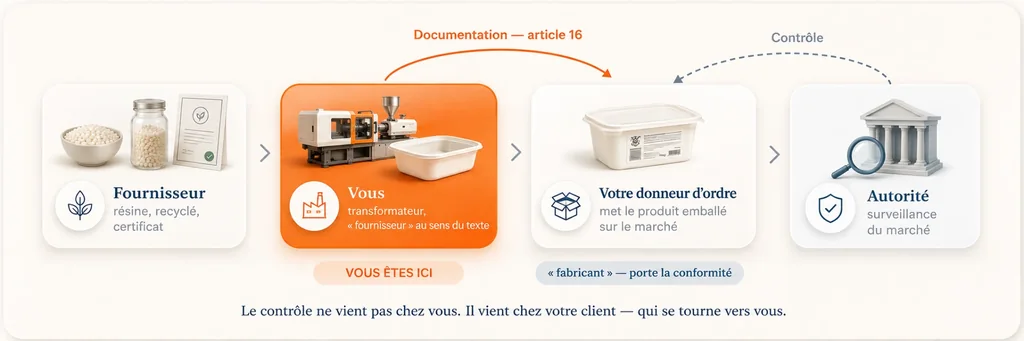
Only post-consumer material counts — the regrind you feed back in does not. Knowing what was purchased will no longer be enough: you will have to know what actually went into a production run.
The official method is not published yet, and we do not sell compliance. We record, at source and batch by batch, what an auditor is likely to ask for.
Regulation (EU) 2025/40, articles 3, 7 and 16.
On a production machine, what is not measured ends up being paid for in material and in lead time.
Micro-stops and breakdowns go unnoticed for hours. That is lost capacity, wasted material already paid for at full price, and customer deadlines under strain.
With no link between process parameters (temperatures, pressures, cycle) and defects, scrap is discovered too late — usually at quality control, with the batch already made.
OEE estimated by feel, no structured history. No way to put numbers on a drop in performance, nor to prove an improvement.
A clear view of your shop floor, live and over time.
The 10 am drop has a reason, a duration and a time.
A stoppage with no reason stays without one. It is not guessed.
Drift shows in the shape of the cycle, not in an hourly average.
Illustrative charts — real shape and reading, demonstration values.
Availability × Performance × Quality, computed machine by machine, in real time.
Automatic detection and logging of stoppages, with reason and duration. No more blind spots.
Set your critical thresholds (temperature, cycle time, extended stoppage) and be notified by e-mail.
Replay a day, a week, a month. Compare teams, part numbers, shifts.
A pragmatic approach that does not touch how your machines run.
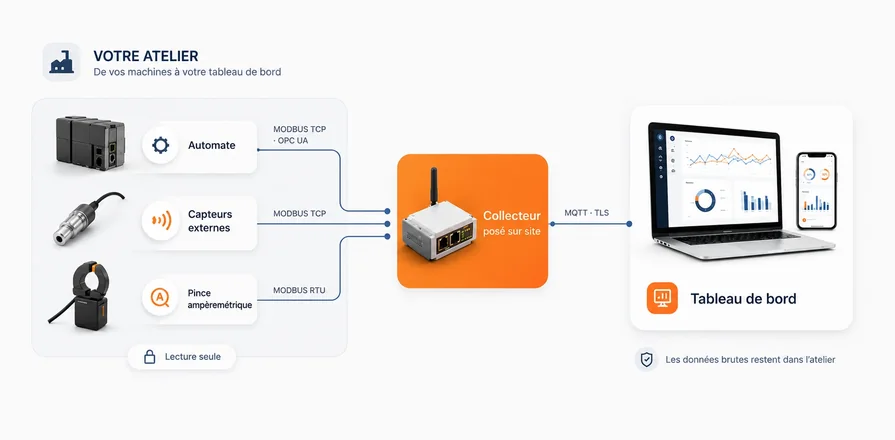
Two options, depending on your equipment:
A small edge collector records the data locally, on your shop floor.
You reach your shop floor from a browser or a phone.
Typical installation: sensors or a controller connection on one or a few machines, collector fitted within the day, first data visible immediately.
The foundation is that of any supervision tool. What follows comes from plastics processing, and is not found elsewhere.
A mould is linked once and for all to a product, a customer, a material and a colour recipe. As soon as it is mounted, production and colour are labelled automatically. No more context entry — and, above all, the two measurements finally speak about the same object.
A ΔE out of tolerance does not just raise an alarm. The L*a*b* components are broken down and translated into a correction: pigment, dosing, temperature, speed. Every correction applied is recorded with the colour before and after — and whether it worked.
Two instruments, two shops, two verdicts on the same part: the classic dispute. Correlation sessions on reference tiles align the fleet, so that a colour rejection no longer depends on which instrument was used.
Every injection cycle is reconstructed from raw telemetry, with its curve. Drift shows in the shape of the cycle long before it appears in an hourly average.
Which resin batch went into which production run, in what quantity, with what declared recycled share and which certificate. That is what makes it possible to issue a batch record — and to separate internal regrind from post-consumer material, which the PPWR does not count the same way.
Material consumed, material actually in good parts, and the gap converted at the price per kilo. Sprues, purges, scrap and set-up stop being a matter of intuition.
Overall equipment effectiveness, rate, availability and quality, updated continuously.
Thresholds, abnormal stoppage and anomaly detection. Notifications by e-mail and webhooks.
Time-series storage, aggregation and long-run trends.
Exportable production summaries, by machine, by shift or by period.
Site / area / machine hierarchy (ISA-95). One interface for several plants.
Access from a browser or a smartphone, on site as well as remotely.
Designed first for plastics processing, applicable across packaging.
Injection moulding, extrusion, blow moulding, thermoforming. Full monitoring of processing machines.
Filling and packing, printing, special lines: collection is process-agnostic, the industry pack is not.
Industrial data is sensitive. Primiot is built so that it stays under your control.
The edge collector records and keeps data on your shop floor. On-premise deployment available so that nothing leaves the site.
MQTT over TLS, authentication by signed tokens (JWT/RS256). Each machine only reaches what concerns it.
Multi-tenant architecture: strict data separation between organisations. Configurable roles and permissions.
MQTT, Modbus, OPC UA. Your data belongs to you and stays exportable. No dependency on a proprietary cloud.
Primiot can be deployed entirely on your own servers, inside your plant: your data never leaves your site, and your installation keeps running on its own, whatever happens to Primiot.
We are not here to teach you your trade. We are here to make your data readable.
Process expertise remains your strength. Primiot concentrates on what it does best: collecting data from your machines and making it readable, in real time. We do not replace that expertise — we make it visible.
We survey what your machines can say, we hand you a first measurement, and you judge on that figure. Our credibility is earned on your machines, not in a pitch.
Non-invasive connection, through external sensors or by reading the controller. We do not change how your machines run: we listen to them. And we work with you, on your ground.
A direct technical contact — not a sales department, not an offshore help desk.
Primiot is designed and developed in-house, in France. In practice, for you: you speak directly with the person who builds the tool, who knows your machines and your deployment — not an intermediary, not a support line on the other side of the world.
“Our job: make your data readable — and prove it on your machines, not in a pitch.”
Primiot is an operational platform. What is at stake on the shop floor is not a software demonstration, it is the connection: every plant has its own controllers, protocols and habits, and what a machine can actually be read for cannot be guessed from a desk.
So we always start by establishing what your machines can say, before talking about installation.
If you are not interested in what comes next, the survey is yours to keep.
Request a surveyNo sales pitch: understanding how you track production today, and what you will have to prove tomorrow. Fill in the form or write to us directly.
Or directly: write to us